
Solve Your Rotational Part Issues
Posted by admin on May 14th 2020
Solve Your Rotational Part Issues
Most coating operations benefit from hanging product within the horizontal and vertical plane of the conveyor, making coating, loading, and unloading of parts relatively straightforward. However, there are instances where this is not practical. In many of these instances, a process of rotation or repositioning of the product is required for either proper coating coverage or to simplify the loading and unloading process.
The most common applications requiring rotation or hanger repositioning include:
- Load, unload, or transfer from a single side of the conveyor
- Spraying both sides of a rack from a single side of the booth
- Spraying geometrically challenging parts
- Continuous rotation of cylindrical parts in a booth
- Preventing rack-to-rack contact in accumulation zones
- Close pack arrangement in ovens of P & F systems
- Improved spray access to transverse mounted racks
- Increased clearance of parts on inclines and declines
Standard Rotation Options

|
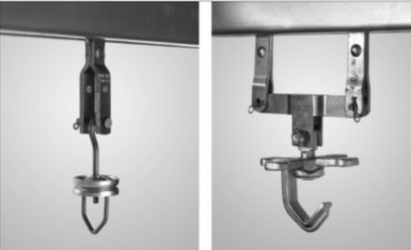
The first four applications listed above represent almost 80 percent of applications for custom coating and OEM requirements. To provide required rotation, rotators or indexers are commonly used. The simplest and most familiar rotator is the “skate wheel,” which turns freely and is usually actuated manually by hand. These are sometimes fitted with a sprocket and can be friction-actuated by a track. The main benefit of this type of rotator is that it is usually the least expensive and typically “in stock.” Yet, it has a limited weight load capacity and sometimes the fact that it can “freely” rotate anywhere can become a problem. Another standard option in the industry is a cast metal rotator that utilizes a small detent to provide an indexing function at 90-degree increments. Its limitations are weight load capacity and that the degree of detent does not control free movements in other areas of the coating system. Controlling this detent can be accomplished with a slightly more customized rotator utilizing a bent (press broken) stainless steel washer saddled by two stainless pins. By adjusting the bend angle of the washer, the amount of force of actuation can be controlled. |
Powered Rotation Options
|
In some instances, applications can be modified for powered actuation. There are typically two types of “powered” rotation applications: friction-driven and motor-driven. Friction-driven utilizes friction created between the moving rotator and a stationary actuation track attached to the conveyor. In either case, the speed of rotation is determined by the operating speed of the conveyor. Friction-driven rotation is appropriate when there is sufficient coating application equipment proportional to the necessary length of travel and/or the control of rotation is not a critical element to the process. There are many applications where simple friction rotation will not do the trick. For example, in electrostatic porcelain powder applications, the high specific gravity of the applied material reduces the powder adhesion characteristics. Any sudden force may cause the powder to “avalanche” off. This potentially tricky situation is ever present at the curing transfer station. When rack elements and contact with the part are less secure due to the preferred hang method, the speed of the conveyor line may also work against friction. High velocity rotation with a sudden stop can cause the part to fly off. In these instances, a more inventive approach is likely needed. A proven technique is implementing a torpedo style rotator with a cycloidal track. A torpedo rotator is designed with two angular, “torpedo” elements mounted with the top element parallel and the bottom lateral to the conveyor. This results in consistently smooth and reliable actuation. |
 |
Finish reading this full article at CEO Scott Rempala’s LinkedIn page, here.