
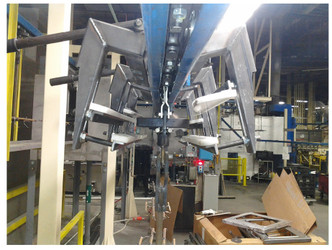
Rotational Devices and Options for Custom Coaters: The Key to Choosing the Right One
Posted by Mighty Hook on Dec 11th 2025
Custom coating applications often run into limitations imposed by system design or by coverage complications due to a part’s geometry. In these instances, part rotation becomes a necessary step of the process. Here are some key tips to help you choose which rotational devices and options are best for your project. Since most coating operations benefit from hanging product within the horizontal and vertical plane of the conveyor, coating as well as loading and unloading of parts is relatively straightforward. However, there are several instances where this is not practical or feasible. In many of them, some process of rotation or repositioning of the work product is required for either proper coating coverage or to simplify the loading and unloading process.
- Determine the Purpose of the Rotational Device
The first step in determining what type of rotational device you require is todefine the purpose you’ll be using it for. Here are a few common examples:
- Loading and unloading or transfer from single side of conveyor
- Spraying both sides of a rack from a single side of the booth (180-degree rotation in booth)
- Spraying geometrically challenging parts (90-degree rotation in booth)
- Continuous rotation of radially symmetrical (cylindrical) parts in booth
These four examples listed represent about 80 percent of the applications for custom coating and OEM requirements. The first two describe limitations imposed by system design and the latter two are limitations imposed by coverage complications due to the coated part’s geometry.
Before choosing your rotational device, it is necessary to have a basic understanding of the common terms which have been used to describe the devices that provide the required rotation. The term rotator usually connotes continuous or intermittent rotation in one direction, while indexer refers to a mechanism that moves back and forth from a detented position. A detent is a design feature creating a mated depression that requires additional force to move it to another position. Either type can be actuated manually or mechanically. The terms rotators or indexers are often used interchangeably.
2. Rotator Types: Choose the one that is most applicable to your project
Controlling the detent, which eliminates unwanted rotation or indexing, can be accomplished with a slightly more custom rotator that utilizes a bent (press broken) stainless steel washer saddled by two stainless pins. Examples are shown in Figures 4 and 5. By adjusting the bend angle of the washer, the amount of force of actuation can be controlled. Upon reaching its designed angle of rotation, the rotator will virtually self-lock and actual upward force on the rack or hanger will be required to move it from its current position. For added security, a locking latch can be incorporated to prevent any unwanted potential positional changes when the latch is engaged (see Figure 6).


Another standard option is a cast metal rotator, as shown in Figure 3. These utilize a small detent to provide an indexing function at 90-degree increments. Again, limitations are weight load capacity and that the degree of detent does not control free movements in other areas of the coating system.
Controlling the detent, which eliminates unwanted rotation or indexing, can be accomplished with a slightly more custom rotator that utilizes a bent (press broken) stainless steel washer saddled by two stainless pins. Examples are shown in Figures 4 and 5. By adjusting the bend angle of the washer, the amount of force of actuation can be controlled. Upon reaching its designed angle of rotation, the rotator will virtually self-lock and actual upward force on the rack or hanger will be required to move it from its current position. For added security, a locking latch can be incorporated to prevent any unwanted potential positional changes when the latch is engaged (see Figure 6).


3. Determine if Powered Actuation is Necessary
Once you have determined which type of rotator is most suitable for your application, you must decide whether or not you will need the rotator to be modified for powered actuation. Powered actuation allows you to forego manual rotation by automizing the rotator. There are typically two types of powered rotation applications—friction driven and motor driven.
4. Deciding between Friction Driven or Motor Driven
Friction driven applications utilize friction that is created between the moving rotator along the continuum of the conveyor that mates with a stationary actuation track attached to the conveyor superstructure. These can be a series of pins mating with a sprocket (referring back to Figure 2) or star wheel or a smooth track when actuating a torpedo or ring-driven rotator (see Figures 7 and 8). In either case, the speed of rotation is determined by the operating speed of the conveyor itself. Friction driven rotation is appropriate when there is sufficient coating application equipment proportional to the necessary length of travel and/or the control of rotation is not a critical element to the process.


In this instance, as well as in others where a smooth transition on automatic rotation of a rack of parts is required, a more inventive approach is typically needed. One of the more proven techniques is  implementing a torpedo style rotator with a cycloidal track. A torpedo rotator is designed with two angular torpedo elements mounted with the top element parallel and the bottom lateral (90 degrees) to the conveyor and are radiused on the leading edges to provide positive drive torque (see Figure 9).The term cycloidal refers to track elements that were adopted from high-speed, cam-driven machine designs that use a simple time versus displacement relationship, aptly named a cycloid. These designs resulted in consistently smooth and reliable actuation.
Without being too technical, the cycloidal track (see Figure 10) contacts with the torpedo along a continuum of a displacement curve, which in effect slows the rotation down substantially from the speed of the conveyor. A depiction of track plotting for a currently employed application is shown in Figure 11. In this depicted application, smooth actuation was obtained on a conveyor moving at 24 fpm. A successful result, indeed.


The second type of powered rotation actually uses a Fdigiurre c9.t C pycolowidealr T osropeudroce to drive the actuation, typically referred to as externally powered rotators. Externally powered rotators benefit from the ability to provide variable speed control and even reverse rotation. Usually they are designed as a single chain element and power a sprocket fitted rotator (see Figure 12). By increasing the speed of the motor driven chain opposite the direction of the travel of the rotator, the rotator can be sped up. Due to the spatial limitations that typically occupy spray booths, this is a good thing as more consistent coating coverage quality can be obtained versus the static friction systems discussed earlier. With variable speed controls, different part sizes and geometries can be virtually “dialed in” for consistent coating coverage.
Well-designed externally powered systems also integrate an instantaneous retraction system, which makes engaging and disengaging rotations safer and quicker. For coating application rotation requirements, these systems are usually the perfect answer.
The rotator and indexer products depicted and discussed up to now assume fixed positions on the conveyor within a pendant, trolley saddle, or H- attachment. However, any of these types of devices can be integrated on properly designed load bars to provide flexibility in hanger and rack spacing.
Companies that have multiple rack designs that need to rotate the hanger for coating coverage or for loading and unloading will experience limitations in line density and therefore efficiency if they are unable to reposition the hangeFrigsu roer 9 .r Cayclkosid awl Thorepned roequired. To combat this, combining rotators with continuous load bar systems, such as angle pivot tooling, results in no reduction in rotational quality as compared to standard conveyor attachments. With the in-plane thrust capabilities of these load bars, the racks or the rotators remain consistently stable when powered drive mechanisms are engaged. Whether racks are manually or automatically rotated for loading and unloading (as in Figure 13) or sprocket friction driven or externally powered rotation (as in Figures 14 and 15), angle pivot continuous load bars provide a great option.


5. Summary
Rotation applications can be made easy with a proper fit to function approach. Intermittent and low volume rotational requirements, as well as many batch coating applications, are the applications typically best suited for the off-the- shelf rotator. However, if coating quality and production efficiency is the key to successful outcomes, then a tailored or engineered design is likely more feasible, whether it be a more customized manually actuated rotator or a more advanced friction or motor powered system.
Notice This post is a synthesised version of an article written by Scott Rempala (CEO of Mighty Hook) and Richard Dooley (former vice-president of engineering for Mighty Hook) for Powder Coated Tough magazine in 2016.
For further reading, see the “Index to Articles and Authors 1990-2017,” Reference and Buyer’s Resource Issue, Powder Coating, vol. 28 no. 6 (December 2017), or visit www.pcoating.com and search the Article Archive by keyword, subject, organization, author, or issue date. All articles listed in the archive are available for free download to registered users.